
The £1.2 Billion Sector You've Probably Not Heard Of (And Why Your Business Should Care)
There's a good chance you've never heard of the VCSE sector. If you have, you've probably heard it called something else: the voluntary sector, the third sector, civil society, the charity sector, VCS, VCFS. The alphabet soup is part of the problem. As Matt Lennard, CEO of the Gloucestershire VCSE Alliance, freely admits, “We really don't help ourselves.” So let's cut through it.
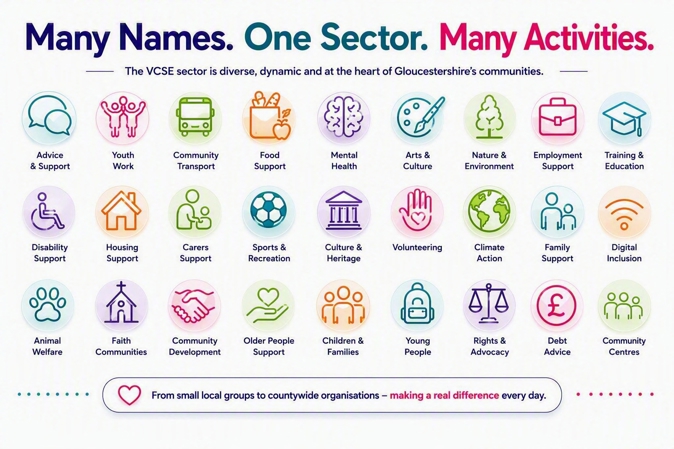
VCSE stands for Voluntary, Community and Social Enterprise. It covers everything from registered charities and social enterprises right down to the Zumba class at the back of the village hall and the local knit-and-natter group. For all their different names and legal structures, they share two threads: they exist to do some kind of social good, and they're not run to line shareholders' pockets. That's it. That's the sector.
And in Gloucestershire, it's enormous.
Bigger than you think
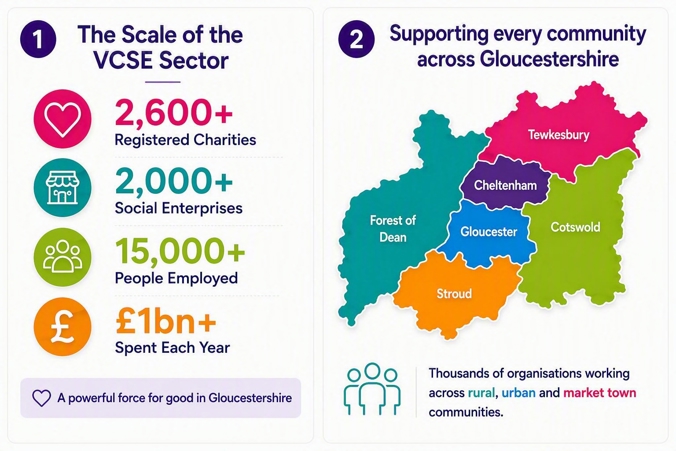
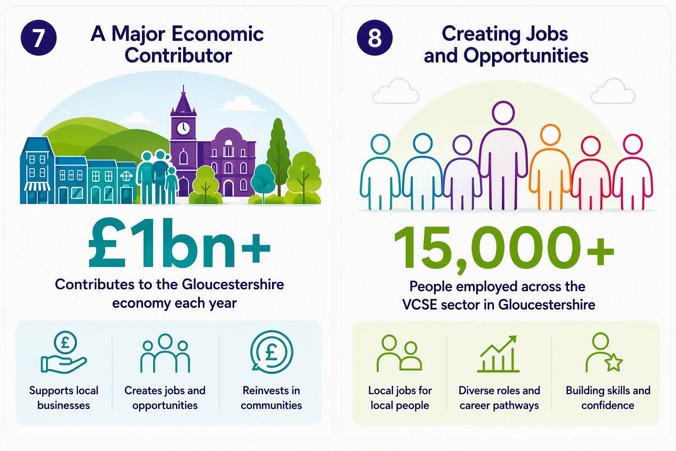
The scale of it catches most people off guard. Gloucestershire is home to over 2,600 registered charities and more than 2,000 social enterprises. The sector employs over 15,000 people and turns over somewhere around £1.2 billion a year, roughly 5.4% of the county's entire economy.
To put that in perspective: Gloucestershire County Council turns over about £700 million a year. The local NHS, around £2.2 billion. The VCSE sector sits squarely between the two, and yet, as Lennard puts it, it's still too often treated as the junior partner, patted on the head for doing “some great work in those communities” rather than recognised as a serious economic force.
There's also a quieter point buried in those numbers and it matters enormously for local businesses: most of that money comes from fundraising and most of it stays local. When a contract goes to a private provider based in London, the profit leaves the county. When the same work lands with a local charity, the staff are local, the services are local and the money is reinvested in Gloucestershire. The VCSE sector is one of the few parts of the economy where the pound you put in tends to stay put.
The Prevention Sector
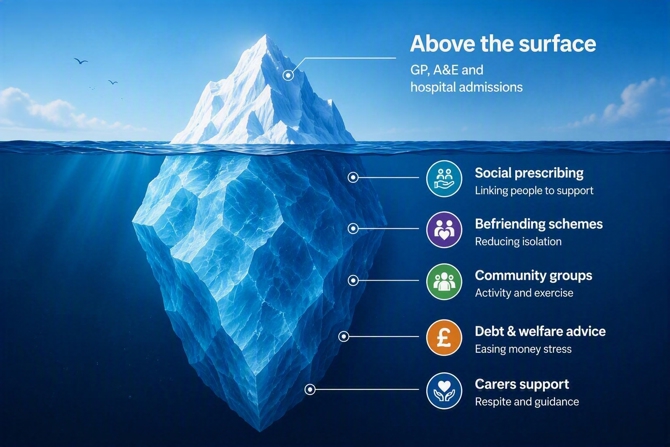
If Lennard could rename the whole sector, he'd call it the prevention sector, as it's the clearest way to understand what it actually does.
Picture an iceberg. Above the waterline sits the visible, expensive tip: GP appointments, A&E, hospital admissions. Below it, invisible but holding everything up, is the vast bulk of the sector's work: social prescribing that links people to support, befriending schemes that ease isolation, community groups that keep people active, debt and welfare advice that takes the edge off money stress, respite for unpaid carers.
Every one of those things stops someone tipping over the threshold into urgent care. Debt advice heads off a mental health crisis. Early support for low-level anxiety stops it becoming a referral to a mental health trust. Access to nature and community keeps people well in ways no clinical service can.
The scale of that quiet work is staggering when you look at the money. Gloucestershire’s voluntary sector has a turnover of over £1.2 billion per year, receiving a fraction of its income from the NHS. As Lennard says, if the NHS pulled its spend tomorrow, the sector would notice and have to scramble. But if the voluntary sector fell off a cliff, the NHS would be instantly flooded with hundreds of thousands of people it currently never has to see. The sector is holding all of them under the waterline, at a fraction of the cost of treating them once they surface.
A sector under real strain
This isn't a good-news story with a comfortable ending, though. The sector is under the most pressure Lennard says he's seen in a long career.
Demand has exploded, especially since Covid. Voluntary-sector mental health services have seen roughly a fourfold increase in need. Young people who once waited three or four weeks for support now wait up to four months. At the same time, costs have jumped: a 16% rise in expenditure, reserves down 11%, and rising National Insurance and National Living Wage bills that hit especially hard because these organisations rightly insist on paying their people fairly.
And the strain isn't evenly spread. The largest organisations are growing. It's the small charities (under £100k a year) and micro ones (under £10k) that are, in Lennard's words, “swirling the plughole.” That's a problem for everyone, because the sector is an ecosystem. When the micro groups fold, their people don't disappear. They resurface further upstream, at higher levels of need, in more expensive services. Charities are now closing at a rate Lennard says he's never witnessed before.
Where businesses come in, and where they often go wrong
This part should interest every business owner in the county and it's where the conversation gets really useful.
Lennard is refreshingly blunt about the current state of business and charity relationships: they're “transactional and lacking depth.” He tells the story of a well-meaning local firm rattling a bucket for a mental health charity they had no relationship with, chosen essentially at random, with no research into local need. The money moved from one pocket to another, and yes, that's better than nothing, but it quietly reinforced a lopsided idea of what the sector is and what it needs.
His sharpest line sounds harsh but arguably needs to be heard to help charities survive. A “charity of the year,” a big cheque, a photo op: these feel generous, but, often without meaning to, they hand resources to whichever cause happens to catch a company's eye, rather than to where the need is. The charity with its finger on the pulse of the community rarely gets asked what would actually help.
And more often than not, what would make the biggest difference isn't money at all. It's information, advice, expertise and the one Lennard bangs the drum for hardest: governance.
Why SMBs are the right partner
This is where small and medium-sized businesses (SMBs) have something big corporates often don't.
Lennard is candid that the Alliance has picked the wrong partners in the past. Some of Gloucestershire's biggest organisations turned out to be “too big, too bureaucratic and too distant from the community” to make anything meaningful happen.
The businesses he would love to have a closer relationship with are family businesses, B Corps and SMBs: the ones that see themselves as part of the fabric of the county, that care about more than the bottom line and that are close enough to their communities to act.
If that sounds like your business, here's what “helping better” actually looks like.
Become a trustee. This is the big one. Every charity is run by a volunteer board of trustees and right now the sector is largely governing itself, with voluntary-sector people advising other voluntary-sector people. Lennard calls it an echo chamber. What it desperately needs is business brains in the room: people who can pressure-test a strategy, sharpen a financial model or bring commercial discipline to a business plan. If your team has a couple of CSR days a year, don't spend them litter-picking on the M5. Spend them on a charity board, where the value keeps paying off all year round.
Offer expertise, not just cash. The thing SMBs take for granted - a proper back office - barely exists in most charities. As Lennard puts it, a charity chief executive is often doing the marketing, the social media, the HR and scrubbing the floor. When an HR crisis hits, there's no one to tap on the shoulder. Lending real skills like HR, finance, marketing, legal or IT plugs a gap the sector simply can't fill on its own.
Bring innovation. Lennard is honest that the sector can be too inward-looking and struggles to think differently, partly because it can't match private-sector wages. Fresh commercial thinking, brought in generously, is one of the most valuable things a business can offer.
Ask first. The single simplest shift: instead of deciding what a charity needs, ask. The Alliance exists precisely to connect businesses with the right organisations and the right kind of support. Its Go Volunteer Glos platform even brokers trustee and volunteer placements directly.
The future that needs building
Lennard's vision, his “future perfect,” as he calls it, is a county where business and the voluntary sector stop treating each other as separate silos and start working a shared agenda: tackling the big challenges together, swapping expertise and opportunity, and keeping money circulating locally.
And he firmly believes the hardest problems are solvable this way. Rough sleeping in Gloucester runs somewhere between 6 and 22 people on any given night, shameful, he argues, in a county this wealthy, and eminently fixable within a year or 18 months if business coordination met voluntary-sector know-how. The same goes for those four-month waits for youth mental health support. These aren't intractable, they just need the right partnerships.
That way of thinking about leadership sits close to our own, and it's part of how we know Matt. He completed our LEAD™ programme via the QuoLux™ Scholarship, which funds fully supported places on the programme for senior leaders of Gloucestershire VCSE organisations. It's our own answer to the same question Matt is putting to businesses here: how do you back the sector with something more useful than a cheque?
So, if you run a business in Gloucestershire, especially a small or family-run one that's ever wondered how you can help more than just raise money, this is the invitation. The sector holding the county above the waterline doesn't mainly need your money. It needs your time, your skills and a seat filled at its table.
Ask what would actually help. The answer might surprise you.
To find out more, or to explore becoming a trustee, please get in touch with the Gloucestershire VCSE Alliance.
You can read more about businesses and the VCSE sector working together in Realising Good Growth, co-authored by Steve Kempster, Emeritus Professor at Lancaster University Management School and Director of its 'Good Growth' Programme, and Dr Stewart Barnes, founder and CEO of QuoLux™, who brings over 30 years' experience of leading, growing and transforming businesses in a range of countries. Their book sets out a practical route for leaders who want their business to deliver more than financial return - exactly the kind of thinking that makes business and VCSE partnership work.
Keep up-to-date on the latest leadership and management tips by signing up to our weekly blog here