How to Choose a Leadership Development Programme: A Buyer’s Guide for SMB Owners
By Dr Stewart Barnes, Founder & CEO, QuoLux™
The right leadership development programme for a Small-Medium Business (SMB) matches three things at once: the scale of your decisions, the way your people learn best and the business outcomes you can already name. Get any of those three wrong and you may spend six figures on just getting smiles in a room. Get all three right and behaviour shifts inside ninety days.
UK SMBs are buying leadership programmes at the highest rate in a decade. The wider market is forecast to keep growing through 2036, and a 2024 evidence review of 65 programme design factors put the average ROI of well-built leadership development between £3 and £11 for every £1 invested, with one manufacturing case study landing at 600 percent. The flip side, also documented in the same review, is that most programmes underperform. Many fail outright. The buyer choice is the variable that flips that coin.
This guide gives owner-managers and HR leads in SMB businesses a structured way to choose. It covers the seven decisions that separate programmes that change behaviour from programmes that fill a binder.
What is a leadership development programme?
A leadership development programme is a structured, multi-month learning experience designed to grow leaders’ self-awareness, skills and decision-making in ways that improve organisational performance. The format ranges from cohort-based peer learning to one-to-one executive coaching, internal academies, business-school open programmes and bespoke organisational development.
For SMB owners and senior teams in companies of 10 to 500 employees, the most evidence-backed formats share three traits: cohort learning with peers from outside your business, real-time application to live business challenges and a feedback loop that runs over months rather than days.
The seven decisions that determine programme fit
Before you compare providers, agree on these seven questions inside your own leadership team. Most poor buying decisions are not provider failures. They are upstream choices the buyer never made.
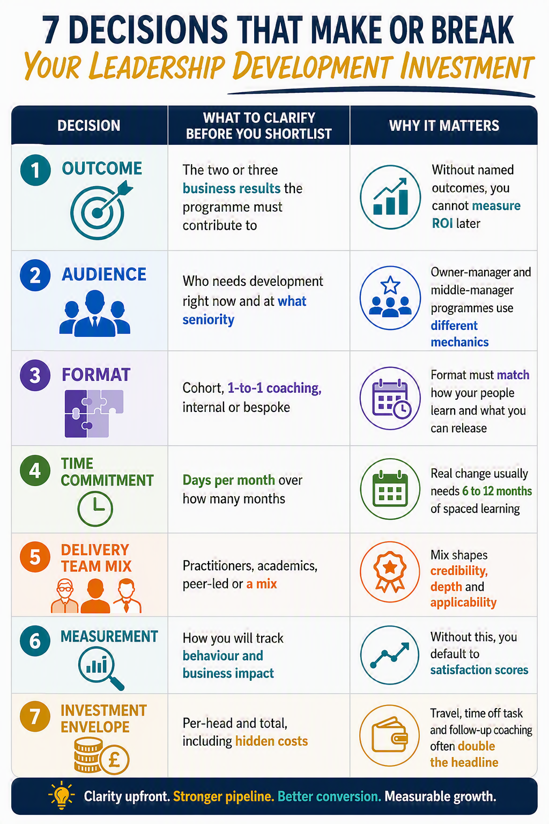
Decision 1: Name the outcomes before you read the brochure
Strong buyers walk into provider conversations with two or three named outcomes the programme must move. Examples that have worked for QuoLux™ clients:
- Owner-manager confidence to delegate decisions worth up to £25k
- Senior team capacity to run weekly business reviews without the founder
- Increase in staff retention
- Strategic plan written, owned and reviewed quarterly by a leadership team rather than the owner
If you cannot name the outcomes, you are not ready to choose a programme. You are ready to do a needs analysis.
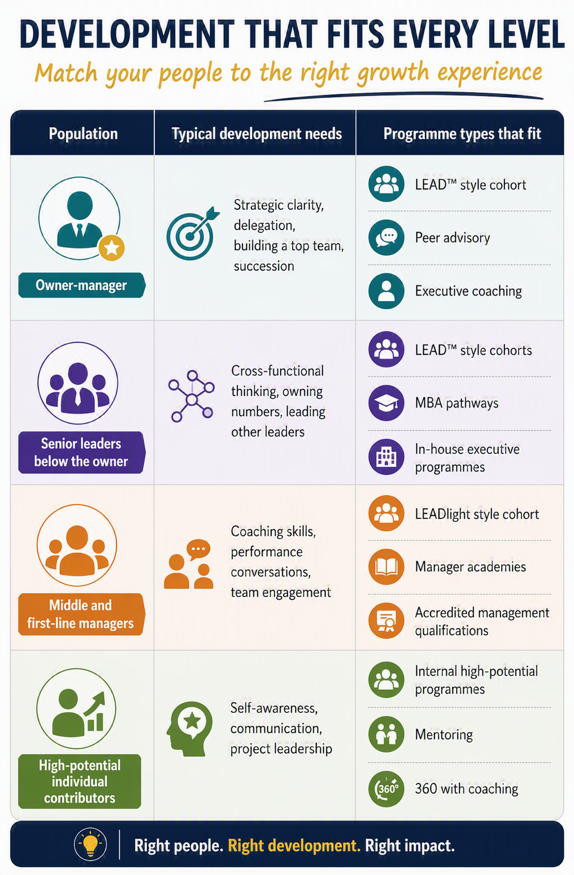
Decision 2: Match the audience to the right development stage
The biggest single mistake we see in SMB programme selection is sending a middle manager on an owner-manager programme, or vice versa. The ‘leadership work’ is different.
Decision 3: Choose the format your people actually learn from
Cohort learning, where leaders learn alongside peers from other businesses, is the format with the strongest evidence base for behaviour change. Research from the Center for Creative Leadership found around 90 percent of leaders rate peer feedback and support as essential to their development. A randomised field experiment in Labour Economics showed peers with different abilities lift each other’s productivity through knowledge sharing.
Use this short test:
- Do your leaders need outside perspective and challenge? Cohort wins.
- Do they have a specific, individual blind spot or transition? Coaching wins.
- Are you trying to shift the culture of an entire layer? Bespoke organisational development wins.
- Do you need a recognised qualification on the wall? Accredited or MBA-pathway programmes win.
Most SMBs end up with a stacked design: cohort programme as the spine, with coaching for individuals who need it and bespoke work where the whole company needs to move together.
Decision 4: Insist on spaced learning across months
The neuroscience of behaviour change is clear. Single events do not change how a leader acts on a Monday morning. Spaced learning, where new ideas are tried in real work between sessions and brought back to the cohort for reflection, is the design that creates change.
A useful filter when comparing providers:
- Programmes shorter than three months rarely change behaviour. They build awareness.
- Programmes spread across six to twelve months with monthly contact points are where evidence shows the strongest behaviour shift.
- Programmes longer than eighteen months tend to lose momentum unless they are integrated into a wider development pathway.
Decision 5: Look at the delivery team, not just the brochure
Ask any provider these four questions and listen for specifics rather than slides.
1. Who actually runs the cohort sessions and what is their direct experience leading SMB businesses?
2. How much of the curriculum is grounded in current academic evidence versus practitioner experience?
3. What proportion of the time is taught content versus peer dialogue and workplace focus?
4. How do you bring in outside voices that participants would not otherwise meet?
The strongest SMB programmes blend experienced practitioner facilitators with academic input where it earns its place. Pure academic programmes can struggle with the messy, real-world pace of an SMB. Pure practitioner programmes can drift into anecdote without rigour.
Decision 6: Decide how you will measure impact
The most cited model for measuring leadership development is Kirkpatrick’s four levels: reaction, learning, behaviour and results. Most buyers stop at reaction. The 2024 Behavioral Sciences framework on maximising leadership ROI sets out 65 evidence-informed strategies, applied before, during, after and well after the programme, that organisations can use to push impact down to levels three and four.
A practical SMB measurement plan looks like this.
- Before: baseline 360 feedback for each participant, plus business KPIs the programme should move
- During: monthly self-rated and manager-rated behaviour check-ins on three to five named behaviours
- End: cohort-level Net Promoter Score and qualitative case studies
- 6 to 12 months after: repeat 360 plus business KPI changes and a structured case study with the participant’s own line manager
If your provider cannot describe their measurement design in specific terms, treat that as a red flag.
Decision 7: Build a real total cost of ownership
The list-price fee is rarely the full cost. A realistic SMB total cost of ownership for a six to twelve month senior-leader programme typically includes:
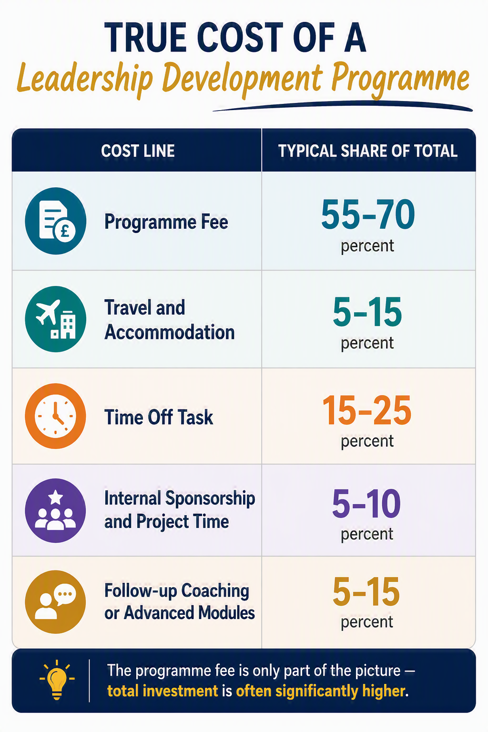
The honest number is what the business actually spends, not the headline on the proposal.
A nine-step buying process for SMBs
This is the process we recommend, refined across almost two decades of working with SMB leaders.
1. Define the two or three business outcomes the programme must move
2. Run a short needs analysis with the leadership team and a sample of participants
3. Decide participants, format and time commitment based on the seven decisions above
4. Set a budget that includes total cost not just the fee
5. Shortlist three providers whose case studies look like your business
6. Insist on a delivery team conversation and references you choose, not the ones they offer
7. Ask each provider to describe their measurement design in writing
8. Pilot with a small group before rolling out widely
9. Build a six-month review point into the contract with a clear exit if outcomes are not moving
Red flags to walk away from
Certain provider patterns reliably predict disappointment.
- The programme depends on a single charismatic facilitator with no backup or peer faculty
- Outcomes are described as “transformation” with no observable behaviours attached
- Cohorts are filled regardless of seniority, mixing operations directors with first-line supervisors
- The provider has no answer to “how do you measure behaviour change six months after the programme ends”
- Pricing is opaque or quoted only after a long sales process
- Case studies are anonymised and impossible to verify with named clients
What good looks like for an SMB owner
A buyer who has done the work shows up with a one-page brief that names the participants, the outcomes, the format, the time commitment, the budget and the measurement plan. The shortlist process then takes weeks, not months. The programme starts with momentum and the leadership team can answer the question every owner asks at month three: is anything changing.
That is a different buying experience from the one most SMBs default to. It is also the one that earns the average £7 return per £1 invested that the leadership development field can deliver when buyers and providers do the work properly.
FAQ
What is the best leadership development programme for an SMB owner-manager?
The best programme for an SMB owner-manager is a cohort-based programme of six to twelve months that includes peers from other businesses, applies learning to live business challenges and measures behaviour change rather than satisfaction. Format matters more than provider brand at this scale.
How much should an SMB budget for a leadership programme per leader?
UK SMB cohort programmes for senior leaders typically cost up to £20,000 per head over six to twelve months, before total cost of ownership. Middle-manager programmes typically range up to £10,000 per head over a similar period. Add 30 to 50 percent for time off task and follow-up coaching to get the real number.
What is the ROI of leadership development for SMBs?
A 2024 evidence-informed framework published in Behavioral Sciences reported leadership development ROI between £3 and £11 per £1 invested, with an average of £7 to £1, when programmes are well designed and well measured. The same review noted most programmes underperform when measurement stops at satisfaction scores.
How long should a leadership programme last?
Programmes shorter than three months tend to build awareness rather than change behaviour. The strongest evidence sits with programmes of six to twelve months, with monthly contact points and structured application of learning between sessions.
What is the difference between coaching and a leadership development programme?
Coaching is one-to-one, tailored to a specific leader’s situation and typically focused on transitions or personal blind spots. A leadership development programme is structured, group-based and aimed at building a shared set of skills and frameworks across a population of leaders. Most strong SMB designs use both: cohort programme as the spine, coaching where individuals need depth.
Do SMBs need accredited or MBA-linked programmes?
Accreditation matters when leaders need or desire a recognised qualification for career progression or regulated sectors. For many SMB owner-managers, the credential matters less than whether the programme actually changes how they run the business. Many SMB leaders choose cohort programmes that offer an MBA pathway as an option for those who want it.
Next steps
If you wish to work with us, then we’d be pleased to discuss our flagship leadership programme, LEAD™. To go to our Case Study Hub, which includes details of ROI on our LEAD™ programme, please click here.
If accreditation matters we can take you through our development pathway to an MBA.
If something bespoke is of more interest then we can discuss options, similarly if you have the development of your first-line and middle managers in mind, let's talk about LEADlight.
Future Market Insights, Leadership Development Program Market Size and Trends 2026 to 2036
Mhlanga, A. et al, Maximizing the Impact and ROI of Leadership Development: A Theory- and Evidence-Informed Framework, Behavioral Sciences, 2024
Center for Creative Leadership, The Power of Peers research summary
Ratcliffe, J. et al, Peer learning in teams and work performance: Evidence from a randomized field experiment, Labour Economics
Kirkpatrick, J. and W., Kirkpatrick’s Four Levels of Training Evaluation

Keep up-to-date on the latest leadership and management tips by signing up to our weekly blog here